

I had a small surgery last week (nothing major), and during the recuperation period I ended up binge-watching One Hundred Years of Solitude on Netflix. I am not much of a TV person, but this was a masterclass in cinema, and I couldn't stop thinking about the show much after it ended. It is a story about the Buendía family that keeps repeating itself. The Buendías possess intelligence, passion, ambition and imagination. What they lack is self-understanding, because it is so hard to see patterns when you are living inside a loop. Over one hundred years, they repeat the same names, the same pride, the same mistakes, until they disappear. Their inability to understand their past becomes their inability to have a future.
The Buendías could not see the pattern because they were living inside it, and I recognised the feeling. For most of my twenties I was inside a loop of my own, obsessing over becoming more talented, more confident, more disciplined, when the thing I needed was a life that was easy to improve.
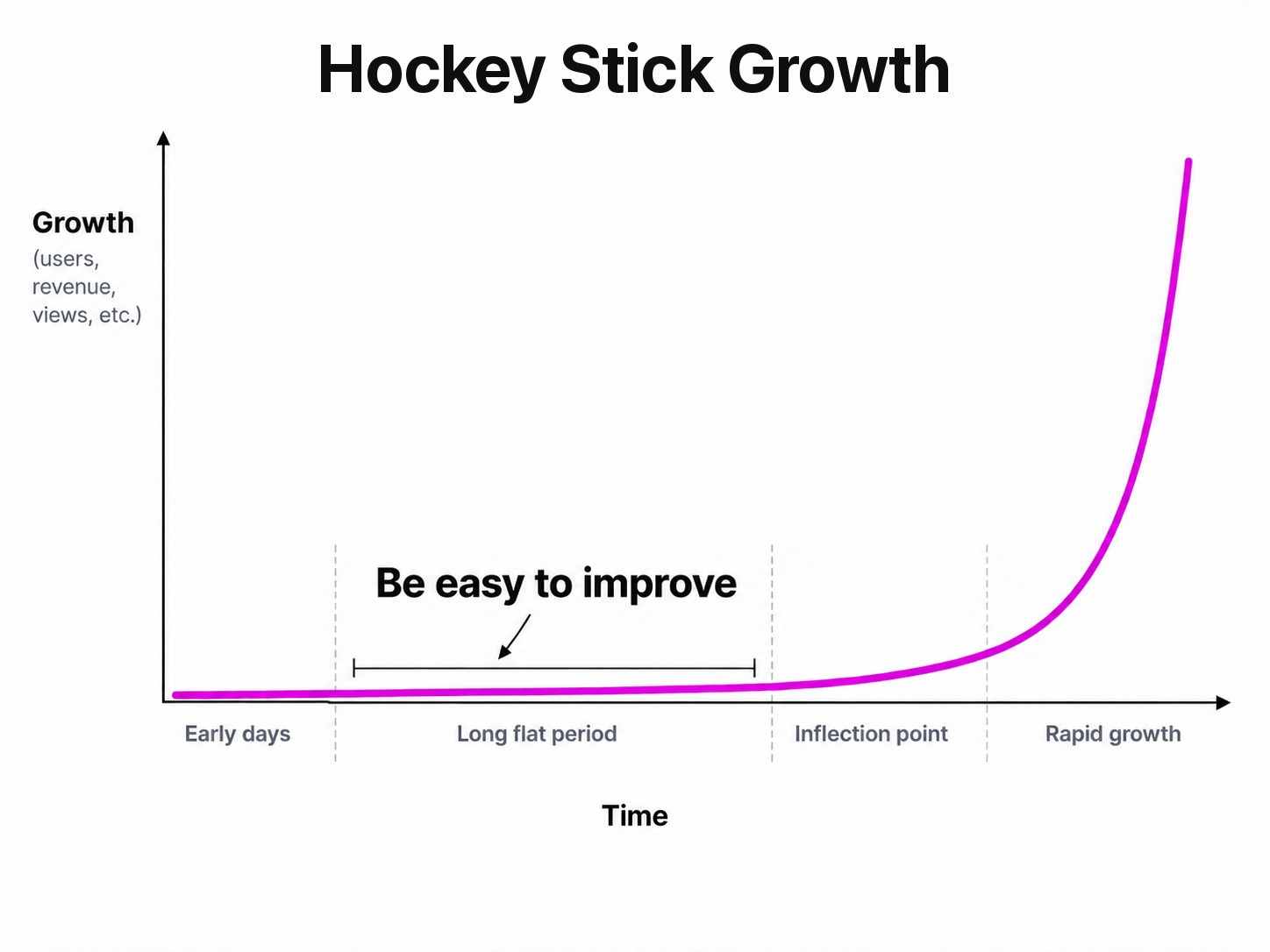
We all have seen this hockey stick in modern self-help books, depicting that if we are persistent enough for a long enough time, steep growth meets us at one end of the time horizon. But no one ever explains the flat part of the graph, a plateau of hope. This is what I want to talk about today.
The narrative of success through sheer unyielding perseverance is a culturally dominant script. However, research reveals a complex reality where effort deployed without a structured feedback loop is not practice but merely repetition. Similarly, ‘failure is the best teacher’ is another misconception. The truth is that failure teaches only when errors are detected, corrective feedback is available, causal reasoning is possible, and the learner remains able to engage. Otherwise, failure can teach helplessness, shame, or the wrong lesson. Humans also suffer from hindsight bias, rationalising failures instead of updating mental models. The Competence Trap makes us protect the ego instead of updating the mental model. So when we hit a plateau, we see it as an identity threat. The result is that we continue putting in more hard work, but without much output.
A life is hard to improve when:
You work privately for long stretches.
You decide whether you are doing well based on mood or effort.
Your identity is too attached to the outcome.
The people you rely on are supportive by being sympathetic rather than critical.
You cannot tell whether the problem is your skill, your offer, your customer, your message, or your assumption.
When is success a bad teacher?
We think success comes from effort over time because that is what our early lives looked like: study harder, work harder, get the result. But these environments had built-in feedback - fixed syllabus, fixed report cards. True for kids growing up through the education system. Hard work, discipline, and the ability to execute remain powerful advantages, together with our own lived experiences, through our adult life as well, but the results start getting more and more unpredictable because now there is no fixed answer key. Nobody tells you what to build, whom to serve, what to charge, which idea is worth keeping, or whether your work is helping. That is why founders can work incredibly hard and still waste years. The issue is not that they do not care. It is that nothing reliably makes the next week smarter than the previous one. This is also true for corporate professionals.
We don’t need a vast research apparatus to begin constructing a new answer key, just a willingness to expose our ideas to real scrutiny and to treat the responses as data rather than validation or rejection of our identity. I did not have an answer key at 25. I had effort. It took me years, and one product I should have killed much sooner, to build habits that bring real progress. These habits killed poor ideas early, stopped some before they started, and led us to build a financial services arm that disbursed tens of thousands of small-ticket loans.
If I were 25 again, I would not wait years. I would start here.
1. Write down what you think will happen
"Ten of the 50 people I message will reply."
"Three founders will pay for this small workshop."
"People are dropping off because the homepage is confusing."
"This essay will get replies from founders struggling with X."
The prediction needs to be clear enough to make a decision, not statistically perfect.
This sounds basic, but it keeps your brain from changing the story afterwards. If you don't write down what you expect before you act, you can explain every result after the fact. You send 40 messages, get one reply, and your brain gives you a story: cold email is dead, the market is slow, people do not get it. Maybe. But you do not know. You never said what you thought would happen, so you cannot see the gap between your model and reality. You do not learn. You just move on.
A group of researchers ran four experiments with 759 firms. Everyone learned the same startup tools: customer interviews, surveys, A/B tests, business-model frameworks. But one group had to do one extra thing: write down why they thought their idea would work, turn that belief into a test, and update it when the result came back.
That group was more likely to kill weak ideas, make a small number of useful pivots instead of either never changing or changing constantly, and performed better overall.
2. Keep a tiny weekly learning log
Once a week, answer four questions:
What were we trying to achieve?
What did we expect would happen?
What actually happened?
What will we change in the next attempt?
Across 46 samples and 2,136 participants, people and teams that ran structured debriefs after work performed about 20–25% better, on average, than comparison groups.
3. Build a truth council
Pick 2–3 colleagues, mentors, investors, or peers who are allowed to disagree with you. Smart people are easy to find, and the real work is making it safe for them to tell you when your story does not match reality.
In my case, I met every Monday with our Head of Technology and Head of Risk. I brought the opportunity, the customer request, or the plan. They brought the questions I was least likely to ask myself: "What are we assuming?" "What breaks if we are wrong?" "What are we not seeing?"
The rule: Reward disagreement. If someone raises a concern, do not defend the plan immediately. Ask, "What are you seeing?" and "What would make this fail?" If people get punished, dismissed, or labelled negative for disagreeing, they will stop telling you the truth.
4. Before you start, run a pre-mortem
Before you start something big, run a pre-mortem. Pretend it is a year later and it failed. Then ask why. In a 1989 study, people who imagined an event had already happened came up with about 30% more reasons for it than people who were merely asked what could go wrong.
Research on "prospective hindsight" found that people generate more explanations when they are told an outcome has already happened than when they are merely asked what might happen. A later study found that this kind of exercise reduced people's confidence in a plan more than ordinary critique or a pros-and-cons list. That is useful because overconfidence is expensive.
5. Lose the ‘I’
There is one thing that breaks every learning loop - putting an ‘I’ before the result.
You launch something. Nobody buys.
You write something. Nobody responds.
You pitch a customer. They say no.
Instead of asking, "What did this tell me about the offer?" you ask, "What does this say about me?"
That is where learning stops.
Researchers looked at 607 feedback experiments and found that performance got worse in 38% of them. The pattern was simple.
Feedback helped when it pointed at the task: "People are dropping off before they see the value."
It hurt when it became personal: "You are not a product person."
The first gives you something to fix. The second makes you want to defend yourself, explain the result away, or avoid the next test altogether. So when you review your work, lose the ‘I.’
Not: I am bad at sales.
Try: I pitched too early in the call.
A deliberate answer key
The Buendías worked harder than anyone in Macondo. Every generation started fresh but ended in the same place. That is what a life looks like when nothing makes next week smarter than last week. You do not need more talent, or more confidence, or more discipline. You need a system that makes it easy for you to improve.
Time is not a line carrying you toward mastery. It is neutral machinery that compounds whatever you feed it, including wrong models, identity-protective narratives, and avoidance of the very feedback that would let you steer. The people who look lucky are running more, tighter loops, and every rep slightly changes the next one. The builder’s real problem is not grit. It is the absence of a deliberate answer key in worlds where no teacher is coming.