

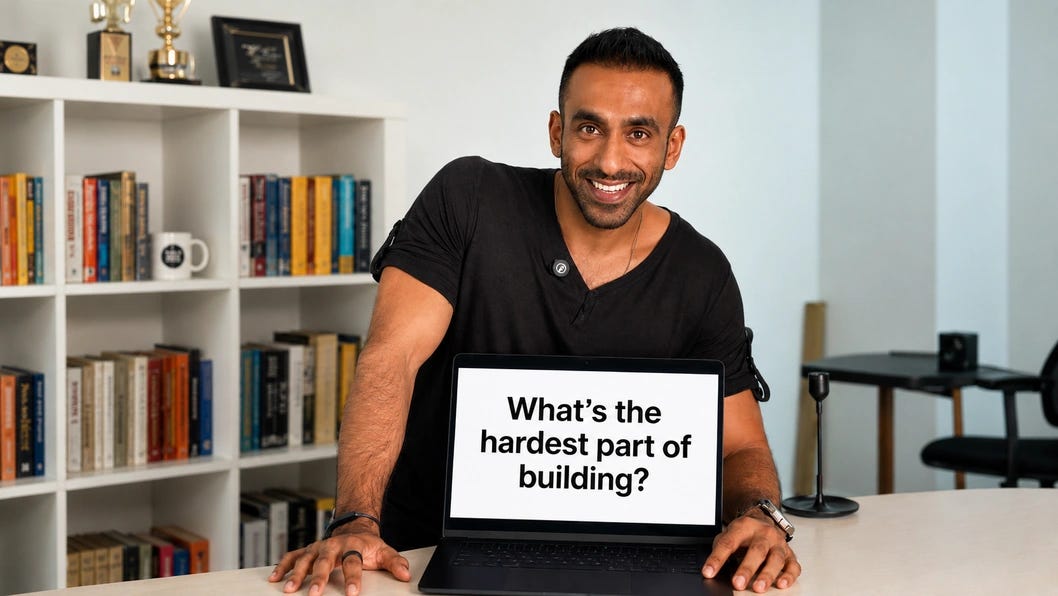
For entrepreneurs and perfectionist founders who hide behind their product, selling is the bravest and final part of building.
There is a romantic myth that good work should speak for itself - that a true creator shouldn't have to stand behind their work and 'ask'. The myth is seductive because it lets fear of exposure wear the costume of integrity. But the truth is that selling isn't the grubby opposite of creation. Rather, it's its final act of creation - and the work only becomes real the moment you stop hiding behind it. It becomes real when you can sell it.
I learned it as a 20-year-old, sitting behind the counter of a liquor store in Washington DC, selling to a Spanish-speaking customer, neither of us being good at English. I learnt it from my cousin Pravesh, who has been the best salesperson I have ever known since then, and he has never once looked like he was selling. Not pushy, as salespersons are generally considered to be, he just listens. He always has the one right thing to say to his customers, and when someone says no, there is always the next person. I watched him that whole summer before I understood that the turning was the secret. My mind kept inventing reasons why I didn't belong behind the counter: my English wasn't good enough, I would never know what to say, I would freeze. So I copied him. His words, his pauses, the way he leaned in, the small nod that told a stranger he was heard. For weeks, I just imitated him. Then, one day, it came naturally.
A woman came speaking Spanish, and I barely spoke English, let alone Spanish. We stood across the counter with no language between us, but the sale happened anyway. Nothing about it should have worked, but it did. That counter was the most important apprenticeship of my life. What I learned there never left me, and it came with me into every room that mattered thereafter. For an introvert who once believed he could never do it, it was the closest thing to a superpower I have owned.
So here is the question that has bothered me for years. We pour ourselves into building our products, then feel embarrassed at the thought of selling them. Why? Is it our nature? Is it that we don't believe we have earned the right? Or that we think the product should speak for itself?
We tell the story of 'making' in two acts: first, you build the thing, then you go sell it. This workflow is the whole mistake. The question is not what comes after the 'making'. Because, at both ends of creation, there's work. The work starts with making and ends with selling. The question you are terrified to ask once the product is finished is the exact question you were supposed to ask before you built anything at all. The question is: will you pay for this? Asked early, with nothing made yet, we call it discovery. Asked late, with the thing in hand, we call it sales. It is one question, posed twice, and the founders who hide from it at the end are usually the same ones who skipped it at the start.
Pravesh, without ever framing it this way, did both at once. Standing at that counter, every sale for him was also a lesson in what the next customer would want. He was selling and discovering in the same breath, learning the market by asking it to buy. That is what the ask actually is: not a transaction bolted onto the end of creation, but the instrument that tells you what to build and whether it was worth building. Refuse to ask, and you have switched off the only sensor that was ever going to tell you the truth.
Market research firm CB Insights read through hundreds of startup postmortems to find the single most common reason companies die. It is not startups running out of money or getting crushed by a bigger competitor. The largest killer, by a wide margin, is building something nobody wanted. Almost 42 per cent of startups die not because the execution failed, but because the thing never needed to exist, and no one found out until the money was gone.
Some founders do ask, hear warm encouragement, build the thing, and still find no real demand. That's because they were listening for applause instead of truth, and people are kind enough to give applause for free. That is a different startup death, and a rarer one. The common death is quieter and sadder: a finished, careful, genuinely good product that starves in a folder, because the person who made it could not step out from behind it long enough to find the single customer it was built for.
That is the real cost of the hiding, laid end to end. To avoid one verdict on your worth, you protect yourself from the exact thing you most need to hear. A no, asked early, is the cheapest truth you will ever buy. A "NO" you spend three years avoiding becomes a single line in someone's research: no market need.
Why are we so afraid to ask?
Here is what I have come to learn after meeting hundreds of builders: building is the most respectable hiding place. As long as you are still building, the work is not finished, and if it is not finished, no one can judge it yet. You get to stay in the warm, private room where the thing is always almost ready and never quite exposed. You add a feature. You refactor the code because it isn't ready yet. You redesign the landing page one more time. From the outside, it looks like perfectionism. From the inside, it feels like progress. It is neither.
It works because making and asking are two completely different acts, and they cost completely different things. Making is private, and endless, and it returns no verdict: you can polish a thing for a decade and never once be told it fell short. Asking is the opposite on every count. It is public. It is a clean yes or no. And the answer never feels like a judgment of the work. It feels like a judgment of you. But being judged is only the surface of it. Go one layer down, and you find something that looks like a virtue and works like a trap.
The people who hide in continuous 'building' are almost always perfectionists, and they wear it as an identity. Ask them why the product still isn't in front of customers, and they will say it isn't ready. But "it isn't ready" is the polite version of a sentence they never say out loud: I haven't earned the right to ask.
So they keep working to earn it. One more proof point, one more month, one more feature that finally makes the thing undeniable, and then they will be allowed to ask. But the line keeps stepping back as they approach it. It always will, because it was never a line in the product. It is a permission, and they are waiting for someone who isn't in the room to grant it.
I know exactly where that waiting comes from, because I come from it. I am first-generation. I was carrying a family's hopes long before I carried a company's. When you arrive somewhere that way, you learn that you are allowed to stay only as long as you out-deliver everyone around you, so you over-deliver by reflex, and the feeling that you have finally earned the right to ask never quite comes.
Psychologist Annie Wright describes this kind of perfectionism as a shield rather than a standard. If the work is flawless, it cannot be criticised, and neither can the person who made it. Sociologist Jo Phelan names what sits underneath it: environments built around an upper-class polish that make first-generation professionals feel like frauds, quietly discouraging them from asserting themselves or claiming their space in the market, no matter how good the work is.
Almost everything you believe about selling is wrong
I have sold to a risk committee at the State Bank of India. I have sold to executives at Vodafone. I have spent twenty years asking strangers for money, attention, and trust, and I have watched what actually works from the only seat that teaches you anything, the one across the counter. Three things I believed about selling turned out to be wrong, and unlearning them is most of the job.
The first: The salesman you are afraid of becoming is not even good at the job. The best sellers I have ever met, starting with Pravesh, barely talk. They ask a quiet question and wait. Adam Grant later put numbers to what that counter taught me: the loud, classic extroverts don't win. The people who outsell everyone are ambiverts, the ask-and-wait kind, who outperform the strongest extroverts by 32 per cent.
The second: That most people will turn me down, so asking is mostly collecting rejection. It is the opposite. Vanessa Bohns has run studies across more than fourteen thousand requests, and people underestimating how often a stranger will say yes by close to half. Saying no is awkward and costly for the other person too. Yes is the easier path for most of us, most of the time. We never account for it because we are stuck on our own side of the counter, never imagining the person across from us is wired to want to help.
The third: that they are judging me the way I judge myself. You finish the pitch, replay every stumble, and assume the other person catalogued the same flaws with the same contempt. Erica Boothby named the opposite the liking gap. After a conversation, people consistently underestimate how much the other person liked them. You hear your own harsh commentary and assume the stranger hears it too. They can't. What they heard was someone offering them something useful, and most walked away thinking better of you than you thought of yourself.
A boy who could not finish a sentence in English sold a case of wine to a woman who could not understand a word he said. I had the proof in my hands at twenty. The research only told me, decades later, why it had worked.
You do not have to change your nature to sell. You never did. Pravesh didn't, the twenty-year-old copying him didn't, and neither do you. The shy, careful, perfectionist builder is not disqualified from asking. He is built for the listening kind of asking that actually works. The only thing standing between you and the ask is a permission you have been waiting for someone else to grant. No one ever will, because no one was ever holding it.
The product never says no
Pravesh never knew he was teaching me anything. He just turned to the next customer, and the next, and the next. I have spent twenty years trying to earn what he had for free: the simple willingness to ask, and to not be destroyed by the answer.
Somewhere right now there is a product that would have changed a life, sitting in a folder, perfect and unseen, because the person who built it could not bear to hear one stranger say no. That is the real tragedy of all this. Not the companies that tried and failed. The ones that were good enough to matter and never got asked about, because their makers mistook the building for bravery. Do not be that maker.
You learned to do the hard part already the day you learned to do anything well. The ask is smaller than the build. It only feels bigger because it is the first time the work and you are finally in the room together.
So make the thing. Then do the harder, truer part of completing it: step out from behind it, find the one person it was built for, and ask. Because asking isn't a betrayal of the work - it's the completion of it, the final brushstroke that completes your masterpiece.
The product never says no. Nor will the product speak for itself. Your product. Your say. Say it!