

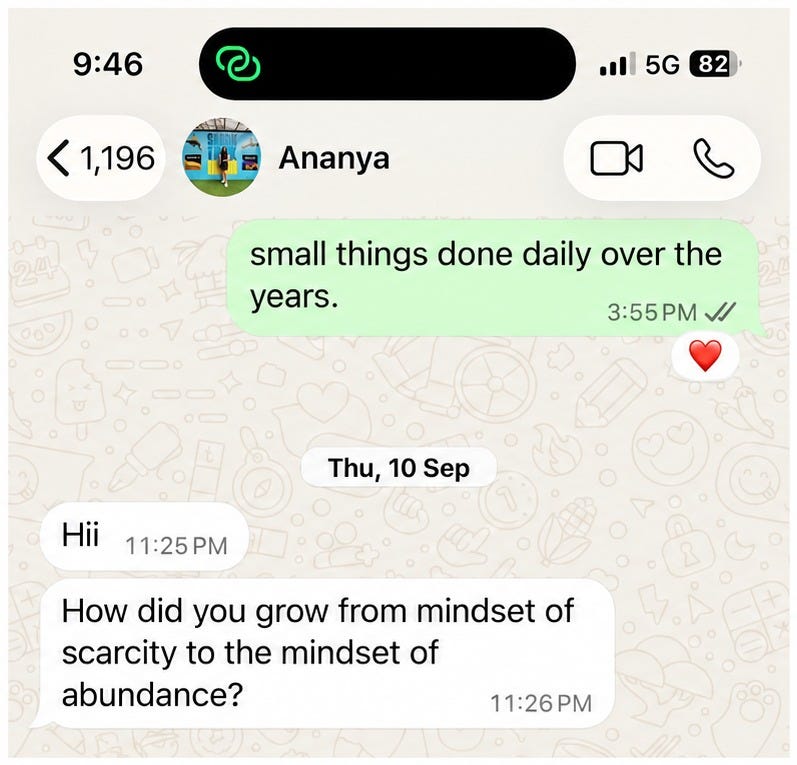
One of my favourite founders one day messaged me on WhatsApp: "How did you manage to grow from a mindset of scarcity to that of abundance?" I pondered over what she had in mind. Not sure of it, I didn't reply. She probably meant how I overcame the handicap of my lower middle-class upbringing to ace not just two startups but also a life of mindfulness. Her amazement is not misplaced because the biological legacy of scarcity ensures that a childhood characterised by scarcity, whether financial, emotional, or opportunistic, permanently alters the brain's threat-detection architecture. The nervous system often remains locked in hypervigilance even after objective material wealth is achieved. I no longer have to think of meeting material needs, but do I still carry the burden?
This is what I wanted to tell my friend.
She reminds me of my mother. Last week, I was loafing around at home.
My mother: "You don't do anything these days. You're always smiling. When I ask what you do for a living, you say you breathe and that you are a liver... What is really a liver?”
I jokingly replied: “I live for living..”
She then sort of taunted me: “You don't remember how hard I fought for our first dining table."
And my mind rushes to my childhood: I'm back there. Small house. Tiny kitchen. We ate in front of the TV. We did not need a table. Once that table came, it became our storage space. Groceries, spices, containers, anything we could not throw away. Years later, we moved to a new house in a new city. But she still brings up that table because it lingers in her head as the internal "storeroom" that carries past scarcity.
This “scarcity storeroom” even extends beyond the material resources to failures, as nothing is thrown away; every rejection and misstep is filed and revisited, under the belief that this protects against future harm. It becomes central to identity, and the person genuinely believes that their success depends on maintaining this harsh archive.
Was my friend expecting this from me?
In that sense, was I supposed to live in judgment and rumination all my life?
Maybe yes. But luckily, no.
I managed to empty my “scarcity storeroom” because I realised something fundamental.
You can't win every bet
High performers generally believe that being hard on themselves is the primary driver of their success. They think that retaining this emotional weight prevents future carelessness. Science, however, reveals that this practice is a measurable cognitive liability.
The book Scarcity (Mullainathan and Shafir, 2013) mentions what having too little does: it narrows your attention. Your head fills with what could go wrong. It makes you keep your failures. Nothing gets thrown away, including old boxes on the dining table, and certainly not the old mistakes.
This holding of failure after you've already learned from it is called failure perseveration.
For a founder who grew up in material and opportunity scarcity, this means that the very habits that once helped them “waste nothing” can silently turn into a cognitive storeroom of failures that is heavier than any one win, slowing them down precisely at the stage where their environment now rewards speed, adaptation, and relational depth.
For them, the BIG FEAR becomes “what if I go back to where I was?”
So all our decisions are pinned on this one thought: "What if this goes wrong?" The argument has merit because there are always obligations to be met (EMIs, etc.).
But when we worry more about outcomes, we fail to realise that, no matter what we do, we can never win every shot. This is a kind of analysis paralysis.
Roger Federer said it best at a graduation speech in 2024. He played 1,526 matches. He won 80% of them. But he won only 54% of the points. "When you lose every second point, on average, you learn not to dwell on every shot." It's not just him. Djokovic's strategy coach ran the numbers on every world number 1 from 1991 to 2016, and found that they won just 55% of points on average.
So no matter what you do, you will not win all your bets. The scarcity mindset all the time strokes fear of failure, acting as a severe cognitive drain that impairs working memory and delays subsequent action, rather than being an engine for higher standards.
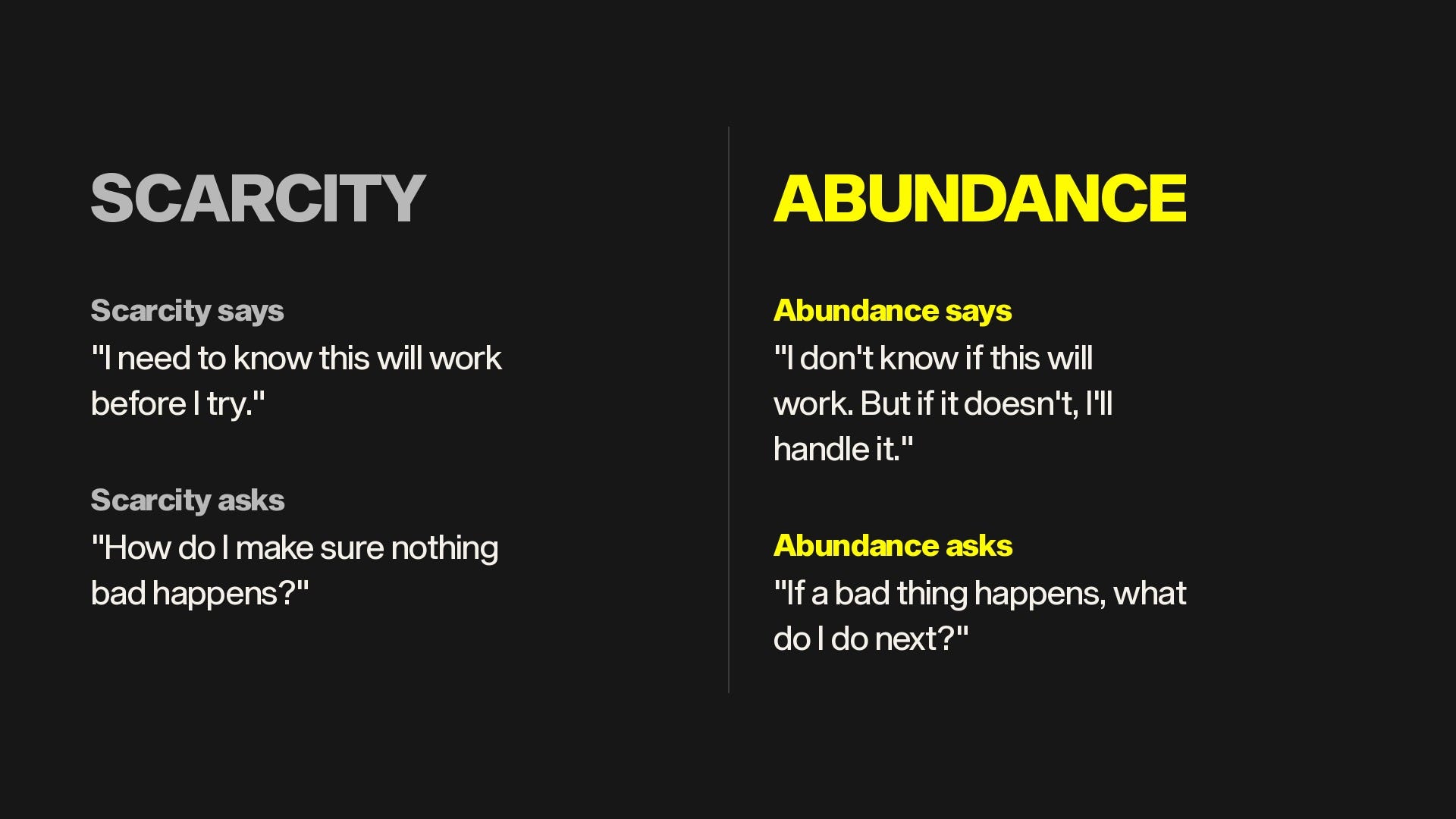
Scarcity vs abundance
Back to my founder friend....
She thinks the positive thinking approach just does not work because all of a sudden you aren't changing your mindset to the idea that the world is abundant.
But it all depends on how we define abundance. If it only means achievement that can produce comfort, security, pride, and autonomy, then real life satisfaction is not guaranteed. Real abundance is about rebalancing aspirations away from wealth, image and status dominance and toward relationships, growth, health and contribution.
Navigating the worst-case scenario
I didn't choose abundance. It was forced on me. We were deep in COVID, and our traditional SaaS business wasn't growing as expected. I knew that it would die a slow death if I persevered with the SaaS play, but COVID made starting a financial services business a no-brainer. I think the scarcity mindset prevented me from making that move earlier. I was already in the worst case. There was nothing left to protect. So the riskiest move stopped being risky. It was just the next move. The financial services business that actually got built was the more attractive one, and that is what CRED was interested in acquiring.
I used to call it luck. But an honest answer is that when I faced the worst-case scenario, I found out that painful is not the same as impossible. I took my shot because I had no choice.
You don't need a pandemic to learn this. There's a cheaper way.
In 2004, Tim Ferriss was making $70,000/month from his first business. But it was also killing him. While working non-stop 14-plus hour days, it became clear he had pushed himself far past his limits. He needed a break, but fear of what might go wrong locked him in a state of paralysis. Luckily, he came up with a solution - “Fear-Setting”, which helped him take a year-and-a-half journey around the world, forming the basis for his book "The 4-Hour Workweek."
The fear-setting exercise: Write the worst case. Be specific. And maybe actually sleep on the floor or just eat rice for a week. Take a rickshaw to commute... live literally below your means. What you will realise is that you will still survive these hard moments. The point is not to convince yourself the worst case is fine. It may be painful. The point is to show your brain that you can fail massively and still survive.
I have since done this exercise regularly - with my fasting schedule, sleeping on the floor, and the obsession with being shirtless - this is easy for me.
Follow by self-forgiveness
I, of course, failed multiple times while building the FS business (now Prefr). But one small thing I changed that kept my abundant mindset was self-forgiveness. If the thing goes badly, your brain will want it to mean something about you. "I'm stupid." "I'm careless." "I always mess this up." "I should have known." Don't skip the lesson. Take responsibility. Fix what you can. Change what needs changing. But don't keep punishing yourself after that.
In a study (Wohl, Pychyl and Bennett, 2010), it was found that students who forgave themselves for procrastinating before one exam procrastinated less before the next. In another study (Breines and Chen, 2012), it was found that students who responded to a failure with self-compassion studied longer and were more motivated to fix things. The fear that forgiveness makes you soft is backwards. Forgiving yourself does not mean letting yourself off the hook. It means getting back in the game faster.
Self‑forgiveness is about clearing the storeroom while retaining the lesson. It acknowledges the wrong, accepts responsibility, reduces immobilising shame, and then commits to enacting change.
So here is my reply to my friend, a few weeks late.
I didn't move from scarcity to abundance by thinking positively. I moved because the worst case showed up, and I was still standing. We can't win every bet. Federer lost almost half his points. My mother lost years to that table. I lost a SaaS business. None of us went back to zero.
The old fear is not stupid. It kept you careful, and careful got you here. But it only knows one question: what if I go back?
So answer it. Write the worst case down. Live it for a week if you have to. This means consciously limiting the time spent in the mental storeroom, extracting lessons quickly, and setting explicit dates to stop paying for specific mistakes. Then look: you're still here. And when a bet goes bad, take the lesson, fix what you can, and put the rest down. Don't carry it into the next one. That's the whole practice. Keep the table. Throw out what's on it.
Abundance is not believing you can't lose. It means experimenting with self‑forgiveness as a disciplined practice, not a vague sentiment, and considering evidence‑based interventions when patterns feel entrenched.
Abundance is knowing that if you lose, you'll handle it.