

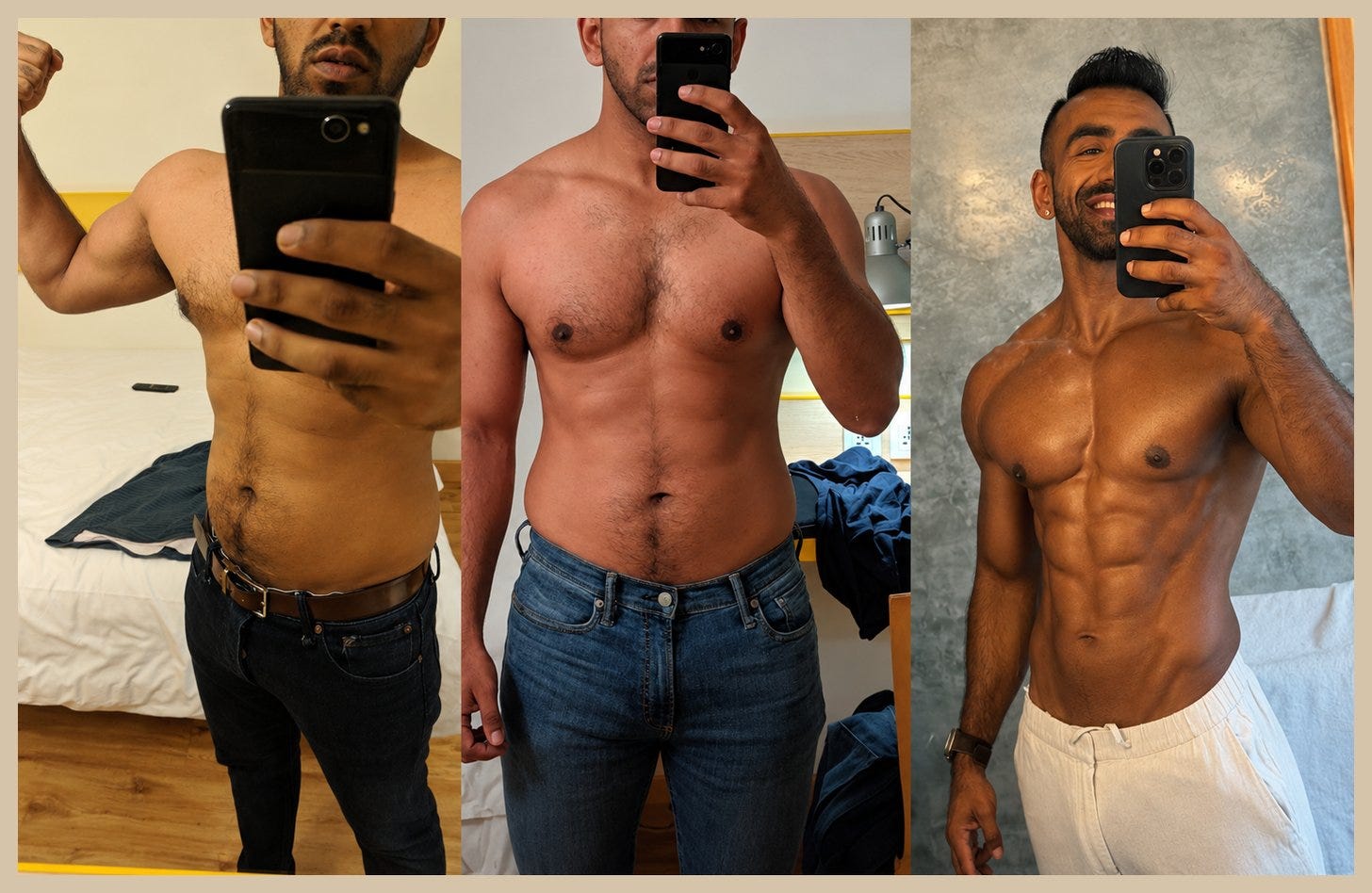
A few compliments I received this month set me thinking how rarely we pause to notice the quiet ways we affect other people. A woman gave me one of those up-and-down looks and said I looked “yummy.” My ten-year-old nephew asked, “Where did you get those muscles?” A random dude walking with his wife outside a coffee shop in Bandra stopped to tell me I was jacked. I consider these compliments as evidence that my effort is working because I have really worked hard for every bit of it. So when one of my friends, visibly impressed with my fitness but failing to be consistent in his own workouts, asked for my advice, I decided to write this letter for him.
We think fit people keep going because they have more discipline. But what if I say that willpower is not a battery, but an emotion sustained by not just how much you are charged up, but how you prolong that charge during dark hours. I attribute my fitness and also success to engineering my way across that “low-status moat” when I had little evidence of my effort producing any results.
The low-status moat is that period of struggle when your effort is yet to produce any results. This matters because it’s easier to keep going once you can see that the effort is worth it. The hard part is continuing before you have that evidence because you can’t cross the low-status moat by just demanding more willpower from yourself. You have to design your way across.
I now no longer need to worry about thinking whether exercise might be worth it; I have experienced what it gives me. That makes continuing easier than it was at the beginning. People have also called me genetically blessed to have a sculpted body. But pictures from five years ago, when I was recovering from a stroke, a slipped disc, and depression, tell a different story about where I started.
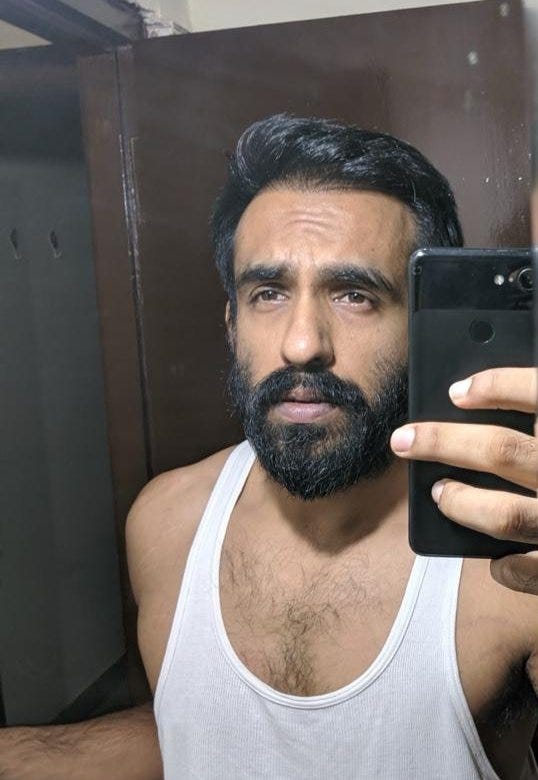
A mountain to climb
On my first day at the gym, a twenty-year-old woman was squatting 40 kg. My coach told me I had some way to go before I could catch up with her. This hit me hard. As a beginner, you are surrounded by people who have already done what you’re struggling to learn, whereas you put in effort without much evidence of results. I wanted to get through that beginner phase. But “try harder” wasn’t much of a plan. So I approached it with my engineering brain. I found out what was likely to stop me, and what I could change before it did that. I couldn’t skip being a beginner, but I managed to reduce the number of reasons that could stop me.
This is how I designed my way across:
1. Manage the decision fatigue
I was running both CreditVidya and Prefr and we had a team of 740 people across six cities. I was busy, but I still needed to find time to exercise. What didn’t work was leaving it open. If I said, “I’ll work out tomorrow,” I would usually skip it. It’s like meetings that aren’t in the calendar: they don’t happen. So I changed “I’ll work out tomorrow” to “I’ll work out tomorrow at 9 a.m.” Then I put it in the calendar. One decision less to worry about.
Researchers call this an “implementation intention” - a specific plan for when, where, and how you’ll act. In an 11-week exercise study, women who made these plans followed their routines more consistently and felt more confident about managing their exercise schedules than the comparison group.
2. Make your next move matter
The second lesson came from selling to Indian banks and financial institutions. A deal can go sour, and you can keep replaying it in your head until it ruins your week. Or you can accept what happened and move on to the next opportunity.
I brought that approach to exercise. If I missed a day, I didn’t beat myself up over it. I just went the next day. Dwelling on a lost deal wouldn’t bring it back. Feeling guilty about a missed workout wouldn’t get it done either. Lay emphasis not on feeling worse about the session you missed, but on making the next one matter. I couldn’t recover yesterday’s workout, but I could stop it from taking the rest of the week with it.
3. Find your ‘Sangha’
Most of my CreditVidya days were spent with clients, investors, and the team. My life was full of people, but very little time revolved around fitness. If I wanted that to change, I had to make room for it.
Vikas was a godsend, someone whose friendship I’m particularly proud to have. He was an endurance athlete, and I deliberately spent more time with him on weekends, whether at Cubbon Park or wherever we could meet. He didn’t have to be my gym buddy. Just being around him, observing his habits, and learning from him motivated me.
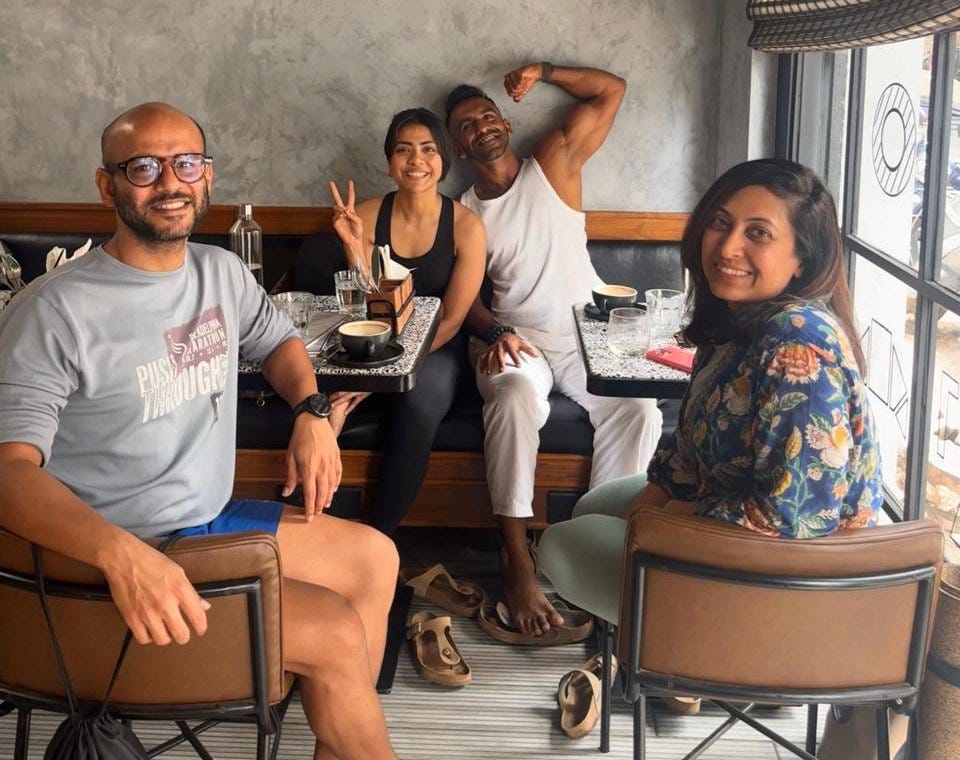
Research shows that office workers report better productivity through observing others and feeling part of a group that encourages movement. For me, that is the practical meaning of sangha: company that supports the direction you want to go. You don’t need to replace your friends or turn every meeting into a workout. But consider making more room for someone whose way of living you want to learn from. I didn’t need Vikas to come to the gym with me. I needed more time around someone for whom fitness already had a place in life.
4. Fixing my emotional food cravings
I love rice. If I had a bad day at the office, I would order dal chawal and some sabji and eat with my hands. Oh Lord, the joy of eating dal chawal. But getting fitter meant making some trade-offs. One of my first changes was skipping breakfast, which helped me reduce my calorie intake. The harder task was preparing myself for that sweet craving. So I changed what I kept at home. I stopped stocking cookies, sugary drinks, and the things I knew I would keep reaching for. But removing things was only half the job. If I knew I would want a snack, I needed something I actually enjoyed eating, not just an empty cupboard and instructions to behave myself. For me, that was watermelon. I kept it cut and ready in the fridge. Watermelon became my replacement for practically every sweet snack. Crucially, I didn’t have to wash it, cut it, or negotiate with myself about what to eat when I got home. That decision was already made.
A Cochrane review of 24 studies found that availability and proximity can influence food selection and consumption. I didn’t rely on my willpower. Instead, I worked with my tendency to reach for whatever was most accessible - and made sure that was watermelon.
5. Pay to learn
The next problem was not knowing what I was doing. Wanting to get fit didn’t mean I knew how to train. I didn’t want to rely on guesswork, not after a slipped disc episode. I’ve been fortunate to find several coaches at different stages of my life. Saurabh, when I was recovering from the slipped disc. Huzefa, who built my foundation of strength. Om sir, who taught me the foundations of yoga. And Manoj, who helped me get comfortable with bodyweight calisthenics and handstands. Each taught me something I didn’t know how to do on my own.
A review of 12 studies found that supervised resistance training may produce greater strength gains than unsupervised training. For me, the choice was practical. I knew how much time and effort it would take to learn everything myself. I would rather pay someone who knew what they were doing, learn from them, and spend my effort practising instead of figuring everything out from scratch. I was lucky to find these coaches, but I also made the decision to reach out.
6. Give yourself enough time
I didn’t grow up athletic, and I certainly am not genetically blessed. I had studied computer science and applied mathematics. So you can imagine how much time I would have spent being on the field. There is a reason I’ve kept this part for the last. Finding a coach, changing what I kept in the fridge, and making time for exercise were things I could act on. Changing how I saw myself needed more time.
James Clear’s Atomic Habits describes identity as something we reinforce through repeated actions, rather than merely declare. I didn’t become consistent because I already saw myself as fit. I had to start doing the work while that description still felt unfamiliar. Over time, my choices changed. I stopped drinking alcohol, limited rice to at most two days a week, and cut out sugary processed foods. But increasingly, they felt consistent with the person I was becoming, rather than restrictions imposed on someone who wanted to live completely differently.
Research finds an association between exercise identity and physical activity. For me, the useful way to understand it is that the actions gave me reasons to reconsider an old description of myself. As that description changed, continuing those actions felt less like a constant argument.
By the time I had crossed the low-status moat, I had started to see myself differently. Fitness had become part of my life, not just a project I was trying to complete. What looked like discipline from the outside felt like a confident choice made by someone who considered himself a fit guy.
Negotiate with oneself
On my first day at the gym, I could see how far ahead of me that twenty-year-old woman was, but couldn’t see how far I might go. If I had treated that comparison as a verdict, I would have mistaken my starting point for my limit.
It is easier for me to keep going now. I know what the effort gives me. I enjoy what my body can do, I like how I look, and yes, I enjoy the compliments. But those rewards weren’t available to the person who first walked into that gym. He had to keep going without them.
That was the difficult part of the low-status moat: showing up when I felt far behind, without knowing how long it would take to improve. I had my share of injuries and periods of complacency. But I had arranged my life so that a setback didn’t mean starting everything from scratch. When I was ready to return, the coach, the routine, and the support were still there.
If you’re used to achieving things by pushing yourself harder, it is tempting to approach an outcome the same way. But the early feedback can be frustratingly quiet. You do the work, look in the mirror, and struggle to see a difference. You can notice yourself getting stronger or learning a skill, but you may still be a long way from the result you wanted. Relying entirely on willpower through that period was more than I wanted to ask of myself.
And although I opened this letter with compliments about my body, I want more from fitness than that. I want to keep doing things I enjoy as I get older. I want to put effort into the body that will accompany me into that future.
So, to the friend I’m writing this for: you don’t have to follow my diet or take up my activities, just to have a body like mine. But if getting fitter is something you want, don’t look at me and conclude that I possess something you don’t. You are seeing me after years of practice, setbacks, help, and adjustments. Give yourself the chance to discover what your own effort might make possible.
Being a beginner told me where I was. It didn’t tell me where I could go.
Awesome results! Thank you for not only telling your story but offering kindness and support to beginners and people who struggle through training everyday. Best of luck for continued success!
Some great tips here - thank you… I will be in touch for a new collaboration