

We have ceremonies like bell-ringing for successful IPOs or celebrations for even small wins. But there's no farewell for a failed startup or other smaller losses. You either celebrate loudly or fade away quietly. Winning has its rituals. Failing is DIY. I'm writing about failure not to preach from the pedestal of two successful brands (CreditVidya & Prefr), but because I still feel like a failure in some ways. This may sound paradoxical, but life is full of contradictions - the one I am describing here from my personal experience is when success feels like failure. Yours may be different, but all failures need the dignity they deserve.
Having built and sold India's top alternative data credit scoring company, I one day found myself sitting in a Bangalore coffee shop, staring at my cold coffee and feeling like a failure because I hadn't built a unicorn. Psychology calls it the 'hedonic treadmill' or the achievement loop, because as we conquer goals, our confidence grows, and the threshold for what constitutes a win expands. In simple words, we are never satisfied. But when we start seeing success as failure, there is something else at work.
Your version of failure might look even different. Maybe it's a product launch that didn't work out as well, a marketing campaign that flopped, a funding round that fell short, or a job interview that didn't go as planned. Sometimes, projects just fade away quietly, with no recognition or sympathy.
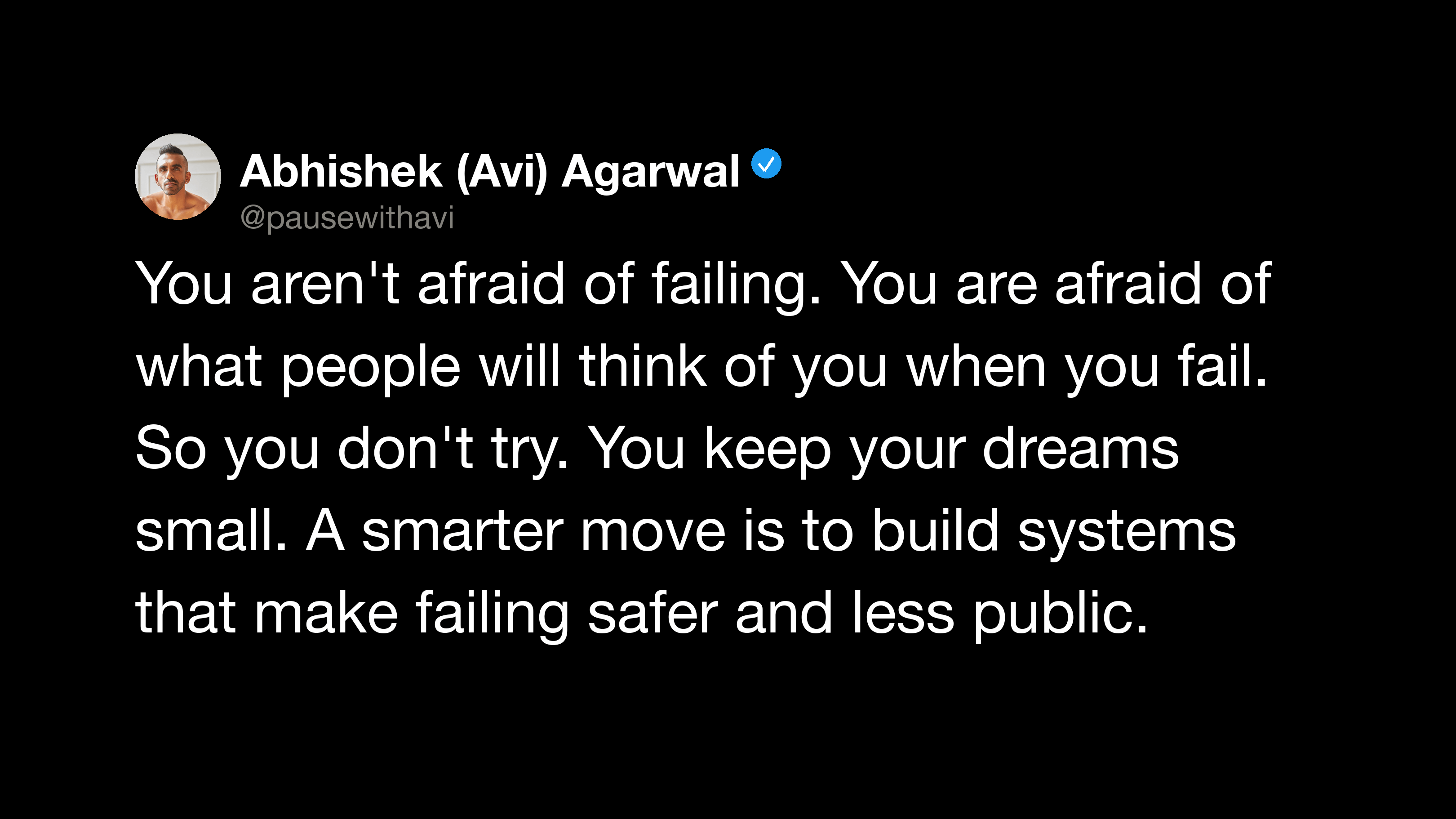
Psychologists have studied fear of failure for a long time. People don't fear the outcome itself, but the shame and exposure that come with it. It's the feeling of "I am a failure" instead of "this failed." This is called a shame-centred pattern. In experiments, people who fear failure often choose easier tasks just to avoid that sting of shame. They aren't really avoiding failure - they're avoiding being seen failing.
That's the uncomfortable truth I want to share.
We have many growth systems. In startups, there's a whole playbook: OKRs, sprints, growth loops, and 360 feedback.
But no one teaches us how to handle failure.
Part I: The illusions of failure
To handle failure better, we first have to stop lying to ourselves.
Illusion #1: You fear shame, not failure
Fear of failure sounds like we are afraid of risk. The uncomfortable truth is that you are not afraid of failing. You are afraid of failing in front of others.
Psychologist David Conroy found that the core of this fear is not losing money or making a mistake. It is the anticipation of shame. The feeling of 'I am a failure' instead of 'this failed.'
You are embarrassed by your batchmates, investors, or parents watching you fail. Stopping means giving up. So you pretend everything is fine and try to push through. Sometimes, the best move is to give up or change direction, but the social pressure does not let us do so.
Illusion #2: You must extract lessons immediately
The startup world loves post-mortems.
We rush to write '10 things I learned' by Monday or quickly move on to the next chapter of our lives: a new job, a new city, a new startup. We call it 'moving faster.'
The uncomfortable truth is that trying to learn too fast makes it hurt more.
Psychologist Dean Shepherd shows that when you force yourself to analyse a big failure right away, your feelings get more intense, not less. You keep replaying every meeting, every email, every 'what if.' You get stuck in loops instead of healing.
It's even harder when other people are involved.
If your company ended because you and your co-founder split up, calling it 'a useful lesson in founder dynamics' can feel like lying to yourself. It feels more like a breakup than a business case study.
If your shutdown used up your parents' savings, telling everyone 'it was just expensive learning' can be a way to avoid admitting that you feel heartbroken and guilty.
But wait a few days, and you won't need a post-mortem of your failure. Just an honest admission - 'This really hurts,' before you try to turn it into wisdom.
Illusion #3: Extreme ownership is not total blame
To survive as a founder, you are told to take extreme ownership. We pour our whole self - breathing, living, eating - into our company.
The uncomfortable truth is that full ownership can turn into identity fusion.
Psychologists use that phrase to describe what happens when the line between you and the company disappears. Your personal self and the startup become one. This is part of what made you powerful as a builder, but it's also what makes failure feel like the end.
If your self-worth is completely tied to the venture, a shutdown feels like 'I am over.' So when you say, 'The failure was and is my fault,' it sounds honest and brave, but inside it turns into, 'I am the failure.'
And if you see yourself as the failure, how can you risk trying again?
Part II: How to overcome the fear of failing
More agency means less fear of failing. Agency means learning what you need to know and solving problems you haven't faced before. You build agency by facing failure again and again. Failing better isn't just a mindset; it's a system.
Exploit the 90-second rule of shame
Neuroscience shows that the physical rush of emotion in your body lasts about 90 seconds. After that, it continues only if your mind keeps replaying what happened.
When you have a tough conversation about a failed project, a closed company, or your own version of failure, don't make excuses or try to justify it. Instead, pause for 90 seconds. Feel your emotions fully. Let them pass, then speak honestly.
Each time you do this, you separate your self-worth from the story you tell. You let the shame move on instead of making it stronger.
Hold a funeral for your failed project
Researchers call this 'witnessed mourning,' which means turning grief into recognised loss through ritual. Hold a 'Startup Funeral' to formally say goodbye to your venture with your team. Join a 'Fuckup Night,' where founders share their business failures in public. Speaking about failure in a safe space takes away its power. You acknowledge the loss, and your mind can finally accept that it's over.
K. Vaitheeswaran, who started India's first e-commerce company before Flipkart, later wrote about fourteen years of Indiaplaza in his memoir, Failing to Succeed. When his wife read the first draft, she broke. She had lived through it all, but this was the first time she could process the loss. The book became their failure's funeral.
Master the two-mode switch: Loss mode vs rest mode
Don't push yourself to find a lesson in failure right away. Doing that often leads to overthinking.
A better approach is to use a simple two-mode switch, which psychologists call oscillation. You intentionally move between two states:
Loss mode is when you let yourself feel the emotions. You might write in a journal, talk, cry, or just sit with the fact that something important has ended.
Rest mode is when you choose not to focus on the failure. You might look for work, go for a run, cook, meet friends, or play with your kids.
Your mind needs both modes.
If you focus on failure all day, you burn out. If you avoid it completely, you stay numb. Switching between the two helps you recharge and learn from the experience later.
Decouple your identity from the failure
You also need to separate who you are from what happened to your company.
This means building other parts of your identity outside of work, like your health, relationships, hobbies, and your role in the community. It also means changing the way you talk to yourself.
Whenever you think 'I am a failure,' change it to 'My strategy failed' or 'This company failed.'
Let go of the idea of being a founder who knows everything. Instead, become a founder who learns quickly.
When you connect your identity to learning, not to the outcome, failure stops threatening your ego. It becomes information you can use to build your agency.
Your next big thing is learning how to lose
The playbook we inherited is clear about success but silent about what to do when things go wrong.
We have systems for growth. When things are going well, there is a framework for everything. When things go wrong, the only rule is "move fast," so we rush past the losses that are shaping us.
Athletes cry on live television after a bad innings or a missed penalty, but they still return for the next game. Founders are expected to smile, 'reframe the learning,' and move on to the next big thing. No tears. No funeral. Just speed.
The greats are not great because they moved faster. They handled loss more healthily. They let it hurt, but they did not let it decide who they could become next.
For me, this has meant less about launching something new again and more about becoming a yoga teacher, writing, and slowly admitting to myself that a part of me is still grieving the company I did not take to IPO.
So here is the only conclusion I trust now:
Your next big thing is not another company.
Your next big thing is learning how to lose without disappearing.
Then, when you are ready, step back in. Not because the world is waiting, but because you are.