

I rarely used to give compliments. After all, praise has to mean something. My logic was that if I held myself to high standards, I expected the same from others. Sometimes I also held back praise to keep myself safe from the embarrassment of flattery. But most often, what held me back was uncertainty in my head about which side my praise would land. And the decision generally came just after the moment the praise actually mattered had already passed. Sometimes it left a lingering regret of being unjust. This problem troubled me for a long time, well beyond my time in ashrams as well. So I finally decided to run a social experiment, hoping to find the reason I held back compliments even when I actually meant so.
The Subko experiment
The experiment was to give compliments to strangers. I chose Subko in Bandra, the Chapel Road one. The only rule was that I couldn’t compliment physical attractiveness. I didn’t want men to be creeped out, and I figured women get complimented on their looks enough. The first couple of days were hard. Someone had nice jhumkas. Someone had put together a thoughtful outfit. Someone had a tattoo that caught my attention. But what was I supposed to say? “Hey, nice tattoo?” Was that enough?
During my year of yoga, I had noticed how my teacher Om sir found something good in everyone. Even if you did something upside down, he would find something worth appreciating. He didn’t need you to get everything right before he could acknowledge what was good. I remember a specific instance where I completely goofed up the Shirshasana (headstand). While correcting my stance, he didn't forget to mention my core strength, predicting that I would be able to master the pose fast.
Probably, I did not have his poise and clarity to acknowledge good things about people I met at Subko. So I tried harder, until I remembered that Om sir did not invent good things to say, but just paid attention to things I might have overlooked. Then I tried meeting people with fresh eyes without being judgemental, and the praise started flowing slowly.
Excellence is work in progress
My lesson from the experiment was that we don't have to lower our standards to become more generous with recognition. Excellence, or aretē in ancient Greek, gives us a broader philosophical frame: look not only at the outcome but also at the qualities expressed in the action - perseverance, fairness, care, and judgment. These qualities can be worth acknowledging even when the final result still needs work. A knife's aretē is cutting well, not how it looks; a horse's aretē is to run well, not winning each time. Aristotle applied it to people. For him, human excellence meant good character shown in what you actually do, like courage, fairness and good judgment.
At Subko, I noticed that I was evaluating before I was appreciating. My thoughts were stuck with questions like - was this really good enough to deserve a compliment? For the perfectionist in me, giving praise too easily felt like lowering the bar.
There is a related concept called “other-oriented perfectionism”: demanding perfection from others, setting unrealistically high standards for them, and evaluating them critically. It goes beyond simply caring about quality to make people feel that nothing is worth acknowledging until everything is right. One possible explanation for this is that we come to associate struggle with improvement. If being hard on ourselves helped us achieve something, we may assume others need the same treatment. Most high achievers see themselves as guardians of quality because frequent praise may encourage complacency, sound like flattery, or lose its meaning. So approval becomes something someone’s work must earn - and the high threshold makes sure not many qualify.
This brings me back to the people at Subko. An ordinary blue might not look remarkable to me. An outfit might just look like an outfit. A tattoo might just look like body art. But someone might have carefully chosen that colour, thought through the outfit, or spent months deciding on the tattoo. My first impression of ordinariness wasn’t necessarily false. It was simply not the whole picture, missing the thought, emotion, choice, or care behind it.
Then I remembered people who had brought out the best in me. I thought of Rajiv Raj, and realised that I didn’t have to lower my standards to become more generous with recognition.
“I know you will figure it out”
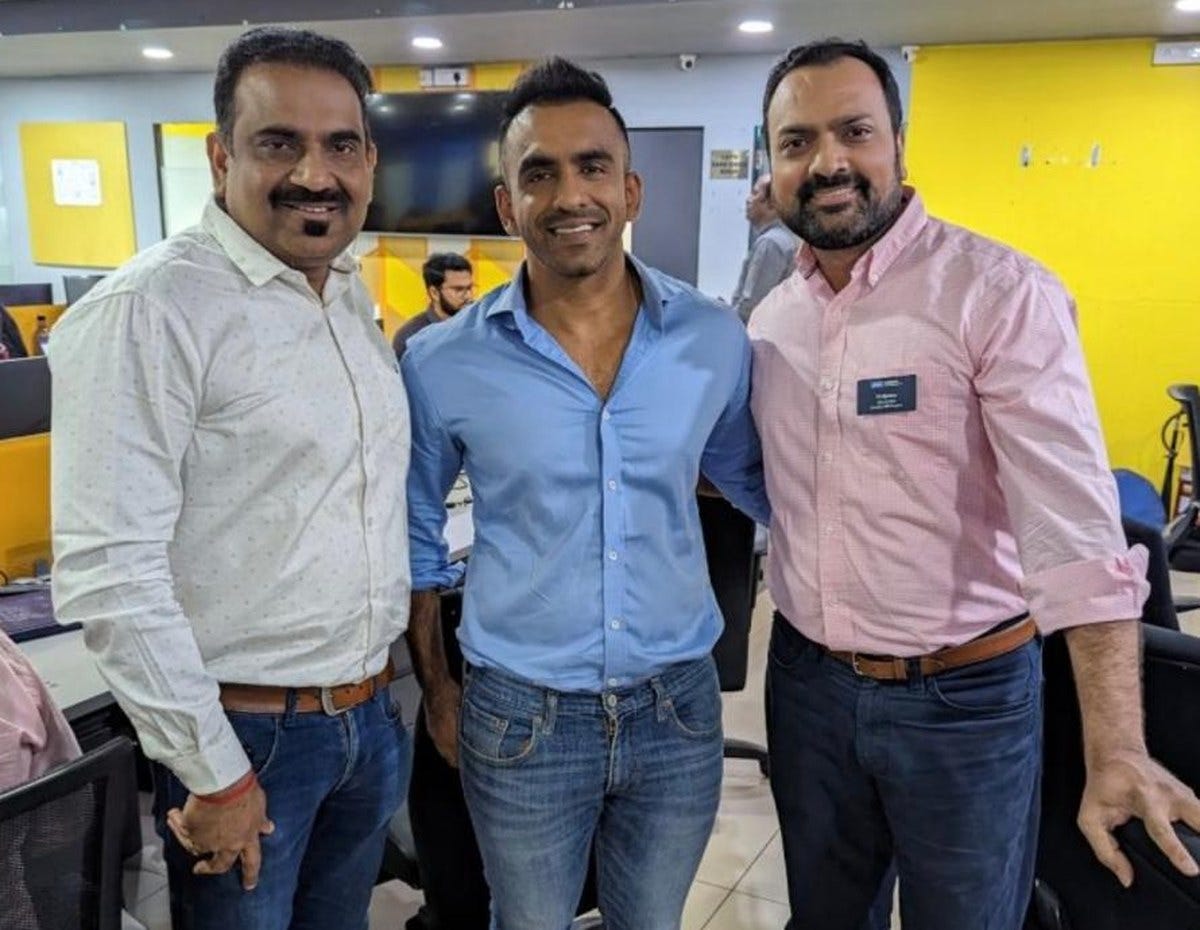
Rajiv was my co-founder and a talent that perhaps I didn’t appreciate enough at the time. A man of highest integrity, he knew how to bring out the best in people. But beyond the integrity, there was something else: the faith he had in people.
During one of the darkest periods of our startup days, we had to lay people off. Then two of our senior people - the COO and CTO - resigned to pursue careers elsewhere. We had six months of money in the bank and an office in Hyderabad with 740 people. I went for a walk with Rajiv. He listened to me and then said: “Remember when we got kicked off the Play Store? You figured it out then. This isn’t the first time we’re shitting our pants. You’ve done this before. I know you will figure it out.”
His words did not give me a direct solution. What he gave me was his trust to figure things out. He didn’t judge me by the expectations he had for himself. I went back with a renewed sense of enthusiasm and self-belief. It all worked out eventually, but in that moment, it simply pulled me out of the dread. You win one day, then the next, and then you win the year.
It reminds me of the quiet “I know you will figure it out” from my mom on our weekly calls. I knew she couldn’t help me with money or make my decisions. These weren’t compliments in the usual sense. They were expressions of belief. Someone I trusted saw a capacity in me that I was struggling to trust myself. The faith someone has in you can help you move mountains.
The Pygmalion Effect offers one research lens to understand this: people’s expectations can influence how they treat others, and that treatment can influence performance. It is not simply about saying encouraging words; it also involves the support, feedback, and opportunities those expectations lead someone to offer.
What connects this to appreciation is not that every compliment can do what Rajiv’s words did for me. It is that noticing something good and expressing it are separate acts, and both need to be performed in sync. Whatever Rajiv saw in me, he didn’t leave me to guess.
Learn to give a good compliment
Businessman and author Doug Conant’s time at Campbell Soup offers an example of high standards and appreciation existing together. By July 2010, his company’s shareholder return was nearly five times the S&P 500’s. He also wrote 10–20 handwritten notes a day, recognising employees’ contributions. Over his tenure, he wrote more than 30,000 notes to a workforce of approximately 20,000. Employees displayed them in their workspaces. These weren’t generic messages sent simply to make people feel good. Conant sought out specific things people were doing right and thanked them. His example shows that demanding standards and expressed appreciation can coexist.
Carol Dweck and Claudia Mueller’s research gives us a similar framework that can come in handy. In their study of fifth graders, 92% of kids praised for their effort chose a harder challenge next. The practical lesson is to give someone more than a label to live up to. Name the action, choice, strategy, or care you actually saw: “You tried a different approach when the first one didn’t work,” rather than only “You’re brilliant.”
At Subko, I had been asking whether something was impressive enough to deserve my praise. A more useful question was: “What do I genuinely appreciate here that I haven’t already said?”
The figure inside the marble
Michelangelo once said: “The statue is already inside the block of marble. My job is only to chip away the stone that hid it.” People are like that block. The person they could become is already there. When you see it and name it, you help chip away the stone. Rajiv did that to me. In a moment when I could see only the problems in front of me, he could still see someone capable of facing them. We don’t get to decide who someone else should become. But we can tell them what we genuinely see: the care they take, the courage they showed, the thoughtful thing they did when nobody seemed to notice.
At Subko, I didn’t know what anyone was carrying. I didn’t know whether they were having a wonderful day or a difficult one. I still don’t know what those little exchanges meant to them. I know they smiled. I smiled too. Not every compliment will become something someone remembers for years. It doesn’t have to. A small moment of feeling noticed is worth offering, even if that is all it becomes.
If you have read this far, thank you for giving me your time and attention. I don’t take it lightly that you chose to spend part of your day here with something I wrote, and end up gaining nothing. Perhaps someone has come to mind as you’ve been reading - a friend, your partner, someone on your team, someone whose effort you have quietly admired. You may have assumed they already knew, or you may have been waiting for a bigger achievement or a better moment. This is the moment. You don’t have to lower your standards. You don’t have to find perfect words. You can simply say: “There’s something I appreciate about you that I don’t think I’ve ever told you.” Maybe, it will help the person feel a little bit better, and you as well.
I still remember Rajiv’s words of encouragement for me. Somewhere, there may be someone who will remember what you say to them.
This was beautifully written. I’d like to think a compliment can change the trajectory of somebody’s life. I’ve experienced those moments myself.
Another thought provoking post Avi! Also Happy Diwali to you!