


The unexamined life is not worth living, but nothing is more difficult than understanding oneself. Self-examination or self-criticism is like a double-edged sword because to see one’s flaws clearly is wisdom, and to see nothing else is blindness. We often inhabit an area where we spend our life accompanied by an internal voice that acts as our harshest critic. This voice eventually becomes indistinguishable from our own thoughts. We expect that our continuous achievement will eventually satisfy this critic, yet the satisfaction never arrives, leaving us exhausted, isolated and sometimes completely in despair.
My moment of despair
We had just pivoted from B2B SaaS to fintech lending. It was the long COVID winter. My head of risk had lost his father. There were six months of cash in the bank. I was crossing a street, a bus came, and for a split second I thought about stepping in front of it. With everything I had built almost collapsing, ending it seemed like the easier way out.
I felt truly scared for the first time in my life.
Why did a business problem become an existential problem? Companies get into trouble all the time. Founders don't usually stand at a crossing and think what I thought.
Self audit
What kind of relationship did I have with the person who had just had that thought?
We spend the maximum time in our lifetime with ourselves. And yet, all our efforts are aimed at improving our interpersonal relationships. I spent years becoming a good character in other people's lives without ever learning how to live with myself. I had built a relationship with everyone. I never built one with myself.
I can describe every important relationship in my life in a few lines.
With my parents: the good kid, the dependable son.
With women: flirtatious, charming, chosen.
With friends: the shameless one who could make a night happen.
With work: disciplined, ambitious, hardworking, demanding, loyal.
Every one of those is a relationship with somebody else. Every relationship is defined by who is in the room. But I never felt the need to be in the room with myself. So, instead of having a conversation with myself, my inner self had been dictating terms to me. High expectations, high standards. When CreditVidya lost hope, I lost hope. My lonely self almost gave a verdict, a bad one.
The voice in my head
Self-criticism as an engine for success fundamentally compromises our well-being and long-term sustainability. Most ambitious individuals spend their lives accompanied by an internal voice that acts as our harshest critic. This voice eventually becomes indistinguishable from our own thoughts. The individual expects that continuous achievement will eventually satisfy this critic, yet the satisfaction never arrives, leaving us exhausted and isolated.
Two pieces of advice generally come up again and again to silence this critic. For me, both looked useless.
Go easy on yourself. Be kind, be forgiving, stop being so hard. My problem with it: if I stopped being hard on myself, I would lose the thing that made me capable.
Get a life outside work. A hobby, friends, something. My problem with it: how am I supposed to do any of that with this much work on the table, when I have payroll to make?
During the CreditVidya crisis, I was frustrated and started writing my thoughts down. I wrote whatever came to mind. In almost every journal entry, I was the villain. All of it was about how I could have done things better. I was my own harshest critic.
The loop that I actually ran
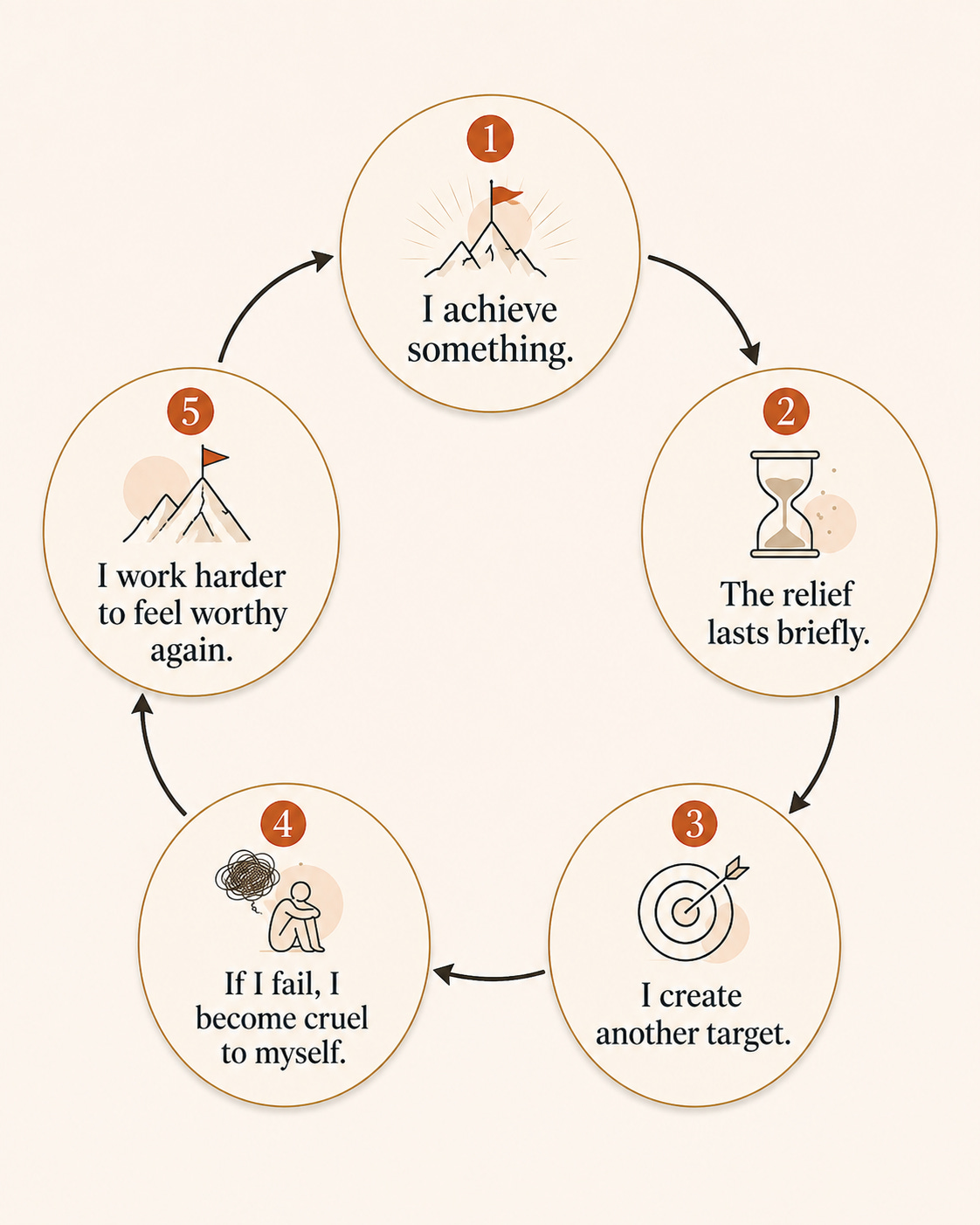
With CreditVidya at stake, my worth went to zero. So in my head, my worth in the eyes of the people I looked up to went to zero as well. And it doesn't stay inside. When we are hard on ourselves, we get hard on everyone else too.
Clinical psychology explains the maintenance of this loop through the lens of evolutionary psychology. Professor Paul Gilbert, founder of Compassion-Focused Therapy, notes that the human brain evolved three primary emotion regulation systems: the threat system (protection and survival), the drive system (resource seeking and achievement), and the soothing system (rest, safety, and connection).
Among high achievers, the threat and drive systems become fused. The individual uses fear, anxiety, and self-criticism to motivate their ambition and hard work. Over years of reinforcement, this neural pathway becomes a superhighway. The individual cannot experience rest because resting disables the drive system, leaving the threat system active and unchecked. This is why "every rest day feels undeserved", and peace is treated only as a contingent reward.
Self-compassion by luck
Following the bus incident, I did something by accident I hadn't done in years. For the first time, I heard myself.
I didn't have a relationship with myself yet. But I heard myself, and I didn't like what I heard. I would never speak to a colleague, a friend, a mentor, a parent or a stranger in the voice and the tone I used on myself.
Just hearing it changed something small. The voice started to lose its grip. That was self-compassion, and I had never felt it before.
We accept ourselves, or love ourselves, or whatever you want to call it, through a lens. That's the relationship lens. And then there's the achievement lens where we believe we will deserve happiness once we arrive. But even that never happens.
What I worked out over the following months was that I started accepting myself for what I was. Never a perfect son. Never a perfect lover. Never enough. And slowly I started putting myself on the line every single time, and something started to happen. The voice in my head began to soften. In a way, I was practising self-compassion.
Self-compassion says: “Let me understand what is happening to me before I judge what I should do about it.”
Self-compassion is acceptance that suffering is inevitable. Even in victory.
Even in modern science, contrary to belief, dopamine is not the chemical of reward. It is the chemical of anticipation and pursuit. It transforms the feeling of "empty success" from a moral failing, a lack of gratitude, or an inadequate achievement into a predictable biological mechanism. Our brain is literally designed to crash its dopamine levels the moment we reach the finish line, meaning the dissatisfaction is a feature of the hardware, not a flaw in our character.
Cruelty was never an engine
Research by Hewitt and Flett theorises that self-oriented perfectionism contains inherent vulnerabilities. When individuals with high self-oriented perfectionism are exposed to achievement-related stressors or failures, their adaptive traits rapidly metastasize into traits like self-punishment, and depression. The loop is maintained because the individual cannot untangle their adaptive conscientiousness from their self-hostility. They fear that letting go of the cruelty will result in a loss of their competitive edge.
A high-performer sees it as a claim about cause and effect: harshness produces performance, softness produces decline. That can be checked. Somebody checked it.
Breines and Chen of UC Berkeley did four experiments on a group of people failing at something. Some members of the group were guided to respond to themselves with compassion. The compassionate group spent more time studying for the retest. More motivation to improve. More willing to make amends after a moral failure. They beat the control group, and they beat a group given a self-esteem boost.
So compassion produced more effort, not less, the exact opposite of what belief predicts.
Cruelty, therefore, was never the engine for success. If anything, it was a tax I paid myself for permission to start.
Maintain your standards
High performers cannot simply "turn off" their inner critic because they experience these thoughts as an expression of ego, deeply aligned with their core identity and credited for their historical success.
When I tell people to take it easy, here's the pushback I get. They hear "lower your standards."
A meta-analysis of 43 studies where they split perfectionism into two things - strivings, which is setting a high bar and chasing it, and concerns, which is fear of and using performance to work out whether you're alright as a person - found that high standards don't predict burnout. What predicts burnout is fear of mistakes, plus using your performance to decide your worth.
So nobody is asking you to dip your standards. Keep them at ten out of ten.
Acceptance is the key
Contrary to the popular belief that self-compassion breeds laziness, empirical studies demonstrate that applying warmth and understanding to one's own failures actually increases self-improvement motivation and academic/professional persistence.
Lately, I have been spending my weekends reading the Bhagavad Gita for the book I'm writing. I have realised that negative thinking, the harshness, the contingent self-worth is the Duryodhana we all have within ourselves. You can't exile him, and you can't beat him.
For years he was winning within me. And I knew that.
He needed to go quiet, and I needed to find Krishna. The Krishna voice was feeble at the start. Then I learnt to be compassionate towards myself. The voice grew louder.
Duryodhana still turns up on occasions. But he just isn't the loudest voice in the room any more.
Self-compassion is the antidote to self-criticism.
Understand your imperfect self.
Thanks for sharing Abhishek!
Abhishek, thanks for sharing your thoughts. I identify with almost all of it. Would be really useful if you could share how you managed to cultivate self-compassion for yourself though. You very rightly pointed out that “taking it easy”somehow translates to “lower your standards”, and while intellectually I understand all of this, it is genuinely SO hard to turn off that critical inner voice. In fact, it has become so second nature to me that most of the time, I don’t even catch myself being that Duryodhana. I’ve tried shadow work, vipassana (where my biggest learning was becoming aware for the first time of the enormous violence I actually practised toward myself), and so many other modalities, but it’s really hard to undo years of self hatred. Shedding some more light on the process of ‘unbecoming’ would be really helpful. Thanks